Verified Material Grade
SS 304 or SS 316 and SS 316L on all product contact surfaces, backed by mill test certificates issued in your company name.





Mecha Engineering fabricates stainless steel rotary extractors at its works in India and erects them at herbal, nutraceutical, tea, oleoresin and licensed hemp processors across Zimbabwe. A rotating drum with internal baffles gives better solvent contact on light, fluffy material, so you get the same yield with a lower solvent bill.
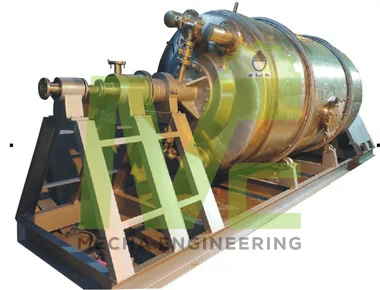
A rotating drum extractor earns its keep on the material a static vessel struggles with: dried leaves, flowers, tea, spices and other light, bulky loads that pack loosely and drain slowly in a fixed basket. The drum turns the bed continuously against the solvent, so contact time drops and the solvent volume needed for a given yield drops with it. That describes most of what Zimbabwe extracts. Tea and coffee from Chipinge and the Honde Valley, rosehip from Nyanga, paprika and bird's eye chilli, moringa and baobab leaf, zumbani and other traditional herbs, and the flower biomass that licensed hemp growers now send for processing.
Buyers searching for a rotary extractor manufacturer in Zimbabwe are usually choosing between a local fabricator and the factory that actually builds the drum. Mecha Engineering is the factory. We build each drum around your feed material, the solvent you run and the discharge method your line needs, at our own works in Saharanpur, India. Design, welding, polishing and trial runs stay under one roof and one engineering team, which keeps the specification honest from drawing to dispatch.
These are the points a Zimbabwean buyer checks before opening a letter of credit, so we put them in writing rather than in a brochure line.
SS 304 or SS 316 and SS 316L on all product contact surfaces, backed by mill test certificates issued in your company name.
Water run, drum rotation and leak test at our Saharanpur shop. Courier a sample of your material and we run a drainage trial before the drum is packed.
Erection, piping tie-in, utility connection, commissioning and operator training at your Zimbabwe site, quoted inside the supply scope.
You buy from the fabricator, not a trading house. No dealer margin, and we quote ex works India as well as CIF Durban or CIF Beira so you can compare landed cost.
Every feature below exists to protect one of two things: the actives in your material, or the hours your operator spends on a batch.
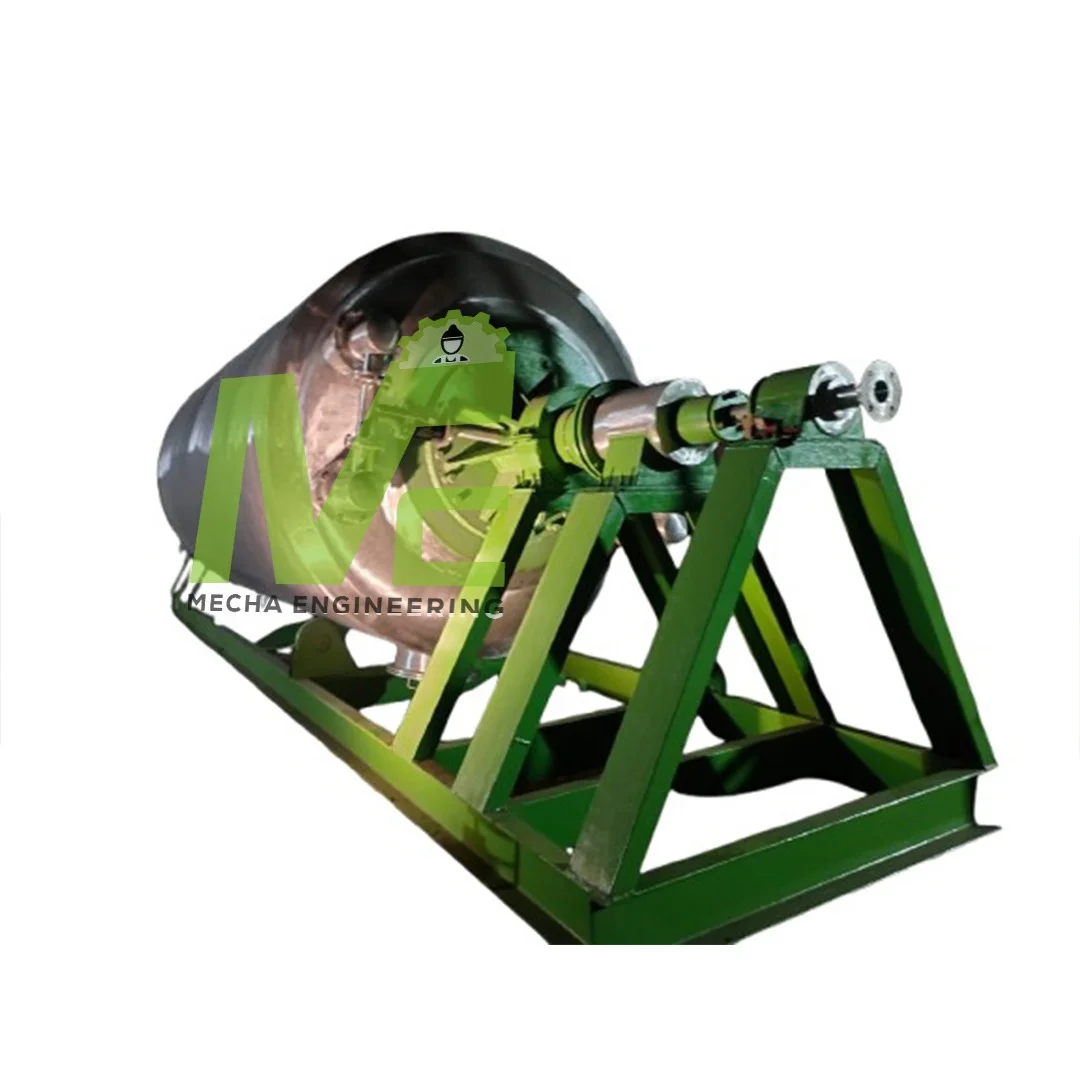
The drum turns on a horizontal axis with fixed internal baffles that lift and tumble the bed through the solvent. Loosely packed material such as leaves and flowers gets even contact instead of channelling through a static basket.
A jacket around the drum shell carries the heating medium, so the material is never in direct contact with a hot surface. Steam, thermic fluid or electric heating is specified to suit what your site has, and heat sensitive actives hold their profile batch after batch.
Large hinged access door for charging, and a rotating discharge that tips spent material out through a bottom or end chute. Turnaround between batches drops instead of holding the line up.
Continuous tumbling shortens the contact time needed for the same extraction, which means a smaller solvent charge for the same yield compared with a static vessel on the same material.
Mineral wool insulation under an SS 304 cladding sheet cuts steam consumption. Internal 220 grit mirror finish keeps changeover between materials practical.
Start with a local panel and manual drum speed control, or take PLC control with HMI recipe storage, batch logging and audit trail when your export buyer asks for it.
Pick the configuration that matches your material and throughput, or send your process sheet and we will tell you which of these fits.
The standard batch unit for a single site. One jacketed drum, condenser and receiver sized for your daily material quantity.
Two or more drums plumbed for counter-current solvent flow, used where a contract manufacturer runs continuous shifts rather than isolated batches.
Horizontal axis drum for bulky, low-density feed such as whole leaves and flower heads, where a vertical basket would bridge and channel.
Shell and tube condenser, receiver and vacuum concentration tied directly to the drum outlet for ethanol or hydro-alcoholic recovery on the same skid.
Feed hopper, drum and discharge conveyor tied together for large volume contract extraction, where material moves through without stopping between batches.
A compact 150 to 500 litre drum for product development and small batch trial work before a full commercial line is ordered, and the unit most new Zimbabwean processors start with.
Standard build for a single drum rotary extractor. Every line below is changed to order, so treat this as the starting point for your enquiry rather than a fixed model list.
| Parameter | Standard offering | Options on request |
|---|---|---|
| Drum Capacity | 150, 300, 500, 1000, 2000 and 3000 litres | Up to 10,000 litres, and multi-drum batteries |
| Material of Construction | SS 304 shell, SS 304 contact parts | SS 316 or SS 316L contact parts, MS jacket to reduce cost |
| Internal Finish | 220 grit mirror polish, around 0.4 micron Ra | Electropolished finish for pharma duty |
| Heating Arrangement | Limpet coil jacket, steam at up to 3 kg per sq cm | Dimple jacket, thermic fluid, or electric heaters where the site has no boiler |
| Drum Rotation | Geared motor drive, fixed speed, 2 to 6 RPM | VFD variable speed control |
| Operating Temperature | Ambient to 100 degrees Celsius | Up to 150 degrees Celsius with thermic fluid |
| Design Pressure | Full vacuum on shell, atmospheric on inside | Pressure vessel design and third party certification |
| Charging and Discharge | Top hinged manhole, end tilt discharge chute | Pneumatic conveying feed, screw discharge |
| Solvent Compatibility | Water, ethanol, hydro-alcoholic mixes | Hexane, IPA, methanol, ethyl acetate with flameproof fittings |
| Condenser and Recovery | Shell and tube condenser with SS receiver | Chilled water condenser, vacuum concentration skid |
| Insulation and Cladding | 50 mm mineral wool under SS 304 cladding | Higher thickness for thermic fluid service |
| Control System | Local panel with temperature indicator and timer | PLC with HMI, recipe storage, batch report, SCADA link |
| Power Supply | 415 V, 3 phase, 50 Hz | Supply voltage changed to suit another site |
| Export Packing | Sea worthy packing with container loading plan and spares kit | Flat rack or open top where the drum diameter needs it |
| Documentation | GA drawing, MOC certificate, test report, manual | DQ, IQ, OQ protocols, weld map, polish and pressure records |
Scroll the table sideways on a mobile screen. Send your material, batch size and solvent and we will fill this sheet in against your process.
The feed material decides the drum design, not the other way around. This is the shortlist we work through with a Zimbabwean buyer on the first call.
| Feed material | Solvent or medium | Best suited configuration | Typical Zimbabwe application |
|---|---|---|---|
| Dried Leaves and Flowers | Ethanol or hydro-alcoholic blend | Horizontal rotary extractor with internal baffles | Zumbani, moringa and herbal remedy makers in Harare |
| Tea, Coffee and Spices | Water, ethanol or ethyl acetate | Single drum extractor with solvent recovery | Tea and coffee extract plants in Chipinge and the Honde Valley |
| Roots and Barks | Ethanol under reflux | Multi-drum battery for higher solids loading | Devil's claw, ginger and root processors |
| Seeds and Oilseeds | Hexane or ethanol | Continuous rotary extraction line | Baobab, marula and moringa seed extract plants |
| Bulky Fibrous Material | Water or hydro-alcoholic mix | Horizontal drum with tilt discharge | Rosehip and large volume contract extraction units |
| Flower Biomass, Licensed Hemp | Chilled ethanol | Horizontal drum with jacket and recovery line | Licensed hemp and botanical extractors |
| New Formulations, Small Batches | Any solvent within design limits | Pilot scale rotary extractor, 150 to 500 litres | Product development units in Harare and Bulawayo |
Not sure which row you belong to? Share the material name and the part used and we will confirm the configuration along with an indicative yield range.
Six stages from raw material to finished extract. Your operator sees the same sequence on every batch, which is what keeps the output consistent.
Material is cleaned, dried to the target moisture and cut or coarsely milled so the solvent can reach it through the tumbling action.
Material goes in through the top hinged manhole, then measured solvent is added to the set solid to solvent ratio before the door is sealed.
The drum turns at a set speed while the jacket brings the batch to temperature. Internal baffles keep lifting fresh material into contact with the solvent.
Rotation slows and the liquid extract drains through a screened outlet. Spent material is tipped out through the end discharge chute for disposal or a second pass.
The extract is concentrated under vacuum. Condensed solvent collects in the receiver and returns to the next batch.
Output is drawn off as liquid, soft or semi-solid extract, or sent forward to a spray or vacuum dryer for a free flowing powder.
Zumbani, moringa and aloe leaf material, where loose dried leaf drains slowly in a static basket but tumbles freely in a drum. SS 316 contact parts and IQ or OQ documentation where the product is registered.
Capsule, tablet and powder makers needing consistent marker compound levels batch after batch, usually with PLC batch logging for the export buyer.
Rotary drums handle the loose leaf from Chipinge and the Honde Valley, and roasted bean material, better than a static basket, giving faster drainage between batches.
Solvent circulation tuned to the density and oil content of ground paprika, bird's eye chilli and ginger, with recovery sized for the solvent volume in use.
Baobab, marula and resurrection bush extracts for the personal care trade, with careful temperature control and food grade construction throughout.
Light flower biomass is the clearest case for a rotating drum, since it bridges and channels in a fixed basket. Licensed operators and multi-product contract units buy for quick changeover and audit readiness.
Extractors are packed at our Saharanpur works and shipped through Mundra or Nhava Sheva to Durban or Beira, then moved by road to site. These are the centres we quote for most often.
Town not on the list? The list is only where we quote most often. Erection and after-sales service cover all ten provinces of Zimbabwe, and we supply other markets in southern and eastern Africa including Zambia, Malawi, Mozambique and Botswana.
Straight answers to what Zimbabwean buyers ask before placing an order.
Mecha Engineering Pvt. Ltd. designs and fabricates rotary extractors at its own works at Village Meharbani on Behat Road, Saharanpur, India. The company was set up in 2022 and supplies extraction, distillation, drying and process equipment to herbal, nutraceutical, tea, spice and cosmetic units in Zimbabwe, across India and in other export markets.
Single drums run from 150 litres for pilot and development work up to 10,000 litres for commercial lines. Multi-drum batteries are built where counter-current flow or continuous operation is needed. Tell us the daily material quantity you want to process and we work backwards to the drum size and the number of batches per shift.
The standard build uses SS 304 for the shell and product contact parts. SS 316 and SS 316L are used where the solvent or the material is corrosive, or where an export audit requires it. Mill test certificates for every plate and pipe are issued in your company name and shipped with the extractor along with the GA drawing and test report.
A static vessel holds the material still in a mesh basket while the solvent soaks through it. A rotary extractor turns the whole drum, so internal baffles continuously lift and tumble the bed through the solvent. That is a real advantage on light, fluffy material such as tea leaf, rosehip, dried herbs and flower biomass, which pack loosely and channel in a fixed basket. Dense material such as roots is often handled just as well, or better, in a static vessel.
Yes. A shell and tube condenser, SS receiver and vapour line sized for your solvent are standard on a recovery-fitted extractor. Ethanol and hexane come back into the cycle rather than going up a vent, and a vacuum concentration skid can be tied to the same outlet for thick extract.
Erection, piping tie-in, utility connection, water trial, the first material batch and operator training at your Zimbabwe site are quoted inside the supply scope. Our engineers travel for commissioning and back your maintenance team afterwards with drawings, video support and a planned spares schedule.
Yes. The standard build is wired for a 415 V, 50 Hz three phase supply, which matches Zimbabwean site power. Heating is specified to suit what you have, so a site with a boiler takes steam, a site without one takes thermic fluid or electric heaters, and the drive and control panel are built around the same choice.
Standard handover covers the general arrangement drawing, material of construction certificates, hydro and vacuum test reports, weld and polish records, the operating and maintenance manual and a spare parts list. DQ, IQ and OQ protocols, along with a validation document set, are prepared on request for regulated and export buyers.
Standard drums are ready in 4 to 8 weeks from order confirmation, and automated or multi-drum plants in 10 to 12 weeks. Allow a further 4 to 6 weeks for sea freight and inland haulage. The extractor is packed sea worthy with a container loading plan, shipped through Mundra or Nhava Sheva to Durban or Beira, and moved by road to your site.
Call +91-9084351006 or +91-7500378000, send a WhatsApp message, or email info@mechaengg.com with four details: the material and the part used, the batch quantity in kilograms, the solvent you intend to use and the form of extract you want at the end. We quote ex works India and on a CIF Durban or CIF Beira basis, usually within one working day.
Share the material, the batch size and the solvent. Our engineering team returns a specification sheet, layout drawing and a price on both an ex works and a CIF basis, so you can compare on paper rather than on promises.