Verified Material Grade
SS 304 or SS 316 and SS 316L on every surface the miscella and oleoresin touch, backed by mill test certificates issued in your company name.





Mecha Engineering designs, fabricates and commissions turmeric oleoresin and curcumin extraction plants in India from its own works at Saharanpur, and supplies them to spice, nutraceutical, ayurvedic and export processors across India and overseas. Lines from a 100 kg pilot batch to 5 TPD rhizome feed, finishing as oleoresin, 95 percent curcuminoid crystals or a water dispersible grade.

India grows more than seventy percent of the world's turmeric, and still exports most of it as rhizome, powder and polished fingers. The curcuminoids inside that crop are worth several times the spice, and the gap has not gone unnoticed: the National Turmeric Board now runs from Nizamabad with a stated export target of one billion dollars by 2030, and the value it is chasing sits in extraction rather than in bagging. Erode, Nizamabad, Duggirala, Sangli, Hingoli and Kondagaon move the rhizome. The oleoresin and 95 percent curcuminoid powder that the world actually buys is made in a plant.
A curcumin extraction plant is what turns one into the other. As the manufacturer, Mecha Engineering starts from the curcuminoid content of the rhizome you actually buy, the solvent your pollution board consent allows and the grade your customer specifies, then sizes the extraction battery, evaporator, crystalliser and dryer around it. Design, fabrication, polishing and trials all happen at our own Saharanpur works, under one engineering team, and the same team erects the plant at your site.
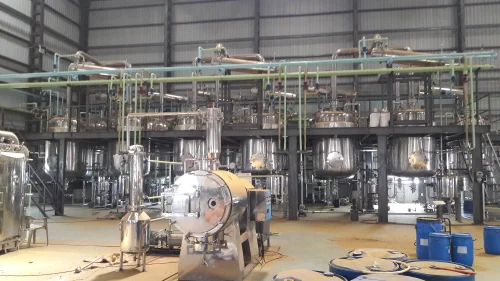
These are the points a curcumin buyer checks before releasing a purchase order, so we put them in writing rather than in a brochure line.
SS 304 or SS 316 and SS 316L on every surface the miscella and oleoresin touch, backed by mill test certificates issued in your company name.
Water run, vacuum hold and solvent leak test at our Saharanpur shop, plus a curcuminoid recovery trial on your own turmeric sample.
Erection, solvent piping, earthing, utility tie-in, commissioning and operator training at your site, covered in the supply scope.
You buy from the fabricator, not a trading house. No dealer margin, and any design change is quoted against actual material and labour.
Every feature below protects one of three things: the curcuminoids in your rhizome, the solvent in your inventory, or the operator on your floor.
Multi-stage counter-current percolation moves fresh solvent against near-spent marc, so residual curcuminoids in the cake stay low instead of walking out with the waste.
Shell and tube condensers, a vent condenser and a desolventiser on the spent marc. Recovery runs in the high nineties, which is what decides the running cost of a curcumin line.
Miscella is stripped under vacuum so the oleoresin never sees the temperature that darkens colour value or degrades curcuminoids in an open boil.
Chilled crystalliser with controlled cooling rate, centrifuge or filter press for the mother liquor, and a wash stage that lifts crystals to 95 percent curcuminoids and above.
FLP motors and panels, nitrogen blanketing, flame arrestors, earthing and bonding, and a solvent storage layout built to pass a factory inspector and an insurance survey.
Start with hand valves and a local panel, or take PLC control with HMI recipe storage, batch logging and an audit trail when your export buyer asks for one.
A curcumin plant is six sections working in sequence. Take the complete turnkey line, or add the one section your existing unit is short of.
Destoner, magnetic separator, hammer mill or micro pulverizer and a vibro sifter bring dried rhizome down to a uniform 40 to 80 mesh, which is where solvent contact becomes predictable.
Feeds every downstream section
Three to six SS percolators on a counter-current cycle with circulation pumps, jacketed heating and a bottom false plate. Ethyl acetate, acetone, IPA or ethanol as your clearance allows.
The heart of the plant
Falling film or forced circulation evaporator followed by a vacuum distillation reactor. Miscella becomes oleoresin, and clean solvent returns to the day tank for the next batch.
Decides your running cost
Jacketed crystalliser with chilled water or brine, slow agitation and a controlled cooling profile, then a solvent wash to strip resin and turmeric oil off the crystal.
Needed for 95% grade
Sparkler filter press, bag and cartridge filters, and a basket or pusher centrifuge to part the crystals from mother liquor before drying.
Protects final purity
Vacuum tray dryer for crystals or a spray dryer for dispersible grades, then pulverising, sifting, ribbon blending to the assay you sell at, and packing under nitrogen.
Delivers the saleable powder
Where most buyers start, and what each size is actually good for. Output figures assume a common 2 to 5 percent curcuminoid rhizome and are confirmed against your own feed assay before quotation.
| Plant size | Turmeric powder per charge | Extraction vessels | Indicative oleoresin per batch | Best suited to |
|---|---|---|---|---|
| Pilot line | 100 kg | 2 to 3 percolators | 8 to 12 kg | R and D, trial batches, assay development |
| Small batch | 250 kg | 3 percolators | 20 to 30 kg | A first commercial line or a spice unit adding extraction |
| Mid batch | 500 kg | 3 to 4 percolators | 40 to 60 kg | Steady oleoresin supply to colour and masala buyers |
| Large batch | 1000 kg | 4 to 6 percolators | 80 to 120 kg | Nutraceutical and export volumes with a purification block |
| Turnkey 1 to 5 TPD | Multi-charge, continuous shift working | 6 and above, counter-current battery | Sized to the daily rhizome feed | Dedicated curcumin units and contract manufacturers |
Scroll the table sideways on a mobile screen. Oleoresin figures move with the curcuminoid content of your rhizome, so we assay a sample before confirming yield.
Standard build for a batch curcumin line. Every line below is changed to order, so treat this as the starting point for your enquiry rather than a fixed model list.
| Parameter | Standard offering | Options on request |
|---|---|---|
| Plant Capacity | 100, 250, 500 and 1000 kg turmeric powder per batch | Turnkey lines from 1 TPD to 5 TPD rhizome feed |
| Feed Material | Dried, cleaned turmeric rhizome milled to 40 to 80 mesh | Whole rhizome, with cleaning and milling section added |
| Feed Curcuminoid Content | Designed around 2 to 5 percent in the dried rhizome | Line re-sized for high curcuminoid Lakadong type feed |
| Extraction Method | Counter-current percolation battery, 3 to 6 vessels | Rotary extractor, or continuous extractor for large feed |
| Solvents Handled | Ethyl acetate, acetone, IPA, ethanol | Hexane defatting stage, methanol, or a solvent-free CO2 route |
| Material of Construction | SS 304 shell, SS 304 contact parts | SS 316 or SS 316L contact parts, MS jacket to reduce cost |
| Internal Finish | 220 grit mirror polish, around 0.4 micron Ra | Electropolished finish for pharma and export duty |
| Extraction Temperature | Ambient to 70 degrees Celsius, jacket heated | Reflux operation at solvent boiling point with condenser |
| Concentration Stage | Vacuum evaporation at 55 to 70 degrees Celsius | Falling film, wiped film or forced circulation evaporator |
| Solvent Recovery | Shell and tube condenser, receiver and vent condenser | Chilled water condenser, marc desolventiser, recovery column |
| Crystallisation | Jacketed crystalliser with chilled water and slow agitator | Brine cooling, programmed cooling profile, second recrystallisation |
| Separation and Drying | Sparkler filter press and vacuum tray dryer | Basket or pusher centrifuge, spray dryer for dispersible grades |
| Typical Output Grade | Turmeric oleoresin, and curcumin crystals at 95 percent | 85 to 90 percent grade, water dispersible blends, turmeric oil |
| Safety Fittings | FLP motors and panel, earthing, bonding, flame arrestors | Nitrogen blanketing, gas detection, sprinkler and hydrant tie-in |
| Control System | Local FLP panel with temperature indicator and timer | PLC with HMI, recipe storage, batch report, SCADA link |
| Documentation | GA drawing, MOC certificate, test report, manual | DQ, IQ, OQ protocols, weld map, polish and pressure records |
Send your rhizome source, daily feed quantity and the grade you sell and we will fill this sheet in against your process.
The grade you sell decides how many sections you need to buy. This is the shortlist we work through with a buyer on the first call.
| Output grade | Process route | Typical assay | Who buys it |
|---|---|---|---|
| Turmeric Oleoresin | Solvent extraction and vacuum concentration | 25 to 40 percent curcuminoids | Food colour, spice and masala houses |
| Curcumin 95 Percent | Extraction, crystallisation, wash and vacuum drying | 95 percent and above | Nutraceutical, supplement and export units |
| Curcumin 85 to 90 Percent | Single crystallisation without a second wash | 85 to 90 percent | Ayurvedic and AYUSH formulators |
| Water Dispersible Curcumin | Blending with a carrier and spray drying | 10 to 20 percent, fully dispersible | Beverage, dairy and functional food plants |
| Tetrahydrocurcumin | Hydrogenation of purified curcumin under pressure | 95 percent and above, colourless | Cosmetic and personal care manufacturers |
| Turmeric Oil | Separated from oleoresin or steam distilled | By-product stream | Aroma, ayurvedic and cosmetic buyers |
| De-oiled Turmeric Marc | Desolventised spent cake from the extractor | Residual only | Cattle feed and biomass buyers near the plant |
Not sure which row you belong to? Share your target customer and order size and we will confirm the route along with an indicative yield per tonne of rhizome.
Six stages from dried rhizome to packed powder. Your operator sees the same sequence on every batch, which is what keeps the assay consistent.
Dried turmeric is destoned, demagnetised and checked for moisture. Anything above the target moisture goes back to the dryer before it reaches the mill.
A hammer mill or micro pulverizer with a vibro sifter brings the rhizome to 40 to 80 mesh. Too coarse and yield drops, too fine and the bed channels.
Powder is charged to the percolators and solvent is circulated stage by stage. Fresh solvent meets the most spent bed, so the miscella leaves the battery at full strength.
Miscella is stripped under vacuum. Solvent condenses into the receiver for reuse and a thick turmeric oleoresin collects at the evaporator bottom.
The oleoresin is dissolved, cooled on a controlled profile and crystallised. Mother liquor is centrifuged off and the crystals are washed to lift the assay to 95 percent.
Crystals dry in a vacuum tray dryer, then go to pulverising, sifting and blending to the sale assay, and are packed under nitrogen in food grade liners.
Capsule, tablet, softgel and gummy makers buying 95 percent curcuminoids with a consistent HPLC assay batch after batch, usually with PLC batch logging attached.
Haridra based formulations, standardised extract lines and AYUSH or GMP units that ask for SS 316 contact parts and IQ or OQ documentation with the plant.
Turmeric oleoresin for natural colour in sauces, bakery, pickles, snacks and masala blends, where colour value and food grade construction decide the order.
Water dispersible and emulsified curcumin for golden milk, shots, juices and functional drinks, produced through the spray drying section of the line.
Tetrahydrocurcumin and purified turmeric extracts for creams, serums and soaps, where a colourless actives stream matters as much as the assay.
Farmer producer organisations and contract exporters adding value to their own rhizome, switching between oleoresin, 95 percent powder and blends on one line.
Dispatch and site service run out of Saharanpur to every state in the country. Open your state below for the local turmeric belt, the buyers we supply there, pollution board requirements and freight.
State not listed yet? The pages above are only where we publish local detail. We dispatch, erect and service curcumin extraction plants in every state and union territory, and export the same plants overseas with sea worthy packing and documentation handled from our side.
Each of these is manufactured at Saharanpur and can be ordered on its own or as part of the turnkey plant.
Straight answers to what buyers ask before and after a site visit.
A curcumin extraction plant is a stainless steel process line that recovers curcuminoids, the yellow actives in turmeric, from dried rhizome. Milled turmeric is washed with solvent in a percolation battery, the miscella is concentrated under vacuum into turmeric oleoresin, and a crystallisation, washing and drying section then lifts that oleoresin to 95 percent curcuminoid powder. A solvent recovery train runs alongside the whole line so the same solvent returns to the day tank batch after batch.
In six stages. Dried rhizome is cleaned and milled to 40 to 80 mesh, charged into counter-current percolators and washed with solvent so fresh solvent always meets the most spent bed. The miscella is stripped under vacuum into oleoresin, the solvent condenses back into the receiver for reuse, the oleoresin is crystallised and washed to raise the assay, and the crystals are dried in a vacuum tray dryer before milling and packing.
Ethyl acetate and acetone are the usual choices for curcuminoid extraction, with IPA or ethanol where a food grade or residual solvent limit applies and hexane for a defatting stage. The plant is built to suit whichever solvent your consent to operate allows, because the condenser duty, vent system and hazardous area classification all change with the solvent.
Batch lines start at 100 kg of turmeric powder per charge for pilot and R and D work and run up to 1000 kg per batch. Turnkey plants are built from 1 TPD to 5 TPD of rhizome feed with multi-vessel counter-current batteries. Tell us the daily turmeric quantity you want to process and we work backwards to the vessel size and the number of batches per shift.
It depends on the curcuminoid content of the rhizome you buy. Common Indian turmeric carries roughly 2 to 5 percent curcuminoids in the dried rhizome, while Lakadong and other high assay varieties sit well above that. A well run plant recovers the large majority of that as oleoresin, with a further loss at crystallisation. Rather than quote a number blind, we assay a 5 kg sample of your own rhizome and give you a yield figure you can budget against.
Both. The extraction and concentration sections alone give turmeric oleoresin at roughly 25 to 40 percent curcuminoids, which is what a food colour buyer wants. Adding the crystalliser, centrifuge, wash stage and vacuum tray dryer takes the same feed to 95 percent curcuminoid crystals for the nutraceutical and export trade. Many units start at oleoresin and add the purification block in the second year.
Cost is driven by five things: the batch size, whether you stop at oleoresin or go through to 95 percent crystals, SS 304 against SS 316 contact parts, manual valves against PLC control, and the level of safety fitment your insurer and factory inspector require. Because those swing the figure widely, we do not publish a single price. Send your daily turmeric quantity, solvent and output grade and a specification sheet with a price comes back within one working day.
Typically a consent to establish and consent to operate from your state pollution control board, a factory licence, a solvent storage and hazardous area approval, and an FSSAI licence where the output is sold as a food or food colour. Export and nutraceutical buyers usually add GMP or FSSC requirements of their own. We supply the equipment list, solvent storage layout and hazardous area details that these applications ask for.
Flameproof motors, FLP control panel and light fittings, earthing and bonding across all vessels and piping, flame arrestors on vents, and a solvent day tank located to the required distance. Nitrogen blanketing, gas detection and a sprinkler or hydrant tie-in are added where your insurer or factory inspector asks for them.
Yes. Erection, solvent and utility piping, earthing, water trial, the first turmeric batch and operator training at your site are part of the supply scope. Our own crew travels from the Saharanpur works with the consignment and stays until the plant has run a full batch on your own rhizome.
Standard handover covers the general arrangement drawing, material of construction certificates, hydro and vacuum test reports, weld and polish records, the operating and maintenance manual and a spare parts list. DQ, IQ and OQ protocols, along with a validation document set, are prepared on request for GMP, FSSAI and export buyers.
A batch extraction and concentration section ships in 8 to 12 weeks from order confirmation. A full turnkey line with crystallisation, drying and PLC control takes 14 to 16 weeks. We dispatch to every state in India and export the same plants overseas, with sea worthy packing, marine insurance and documentation handled from our side.
Share your daily turmeric feed, the solvent you are cleared for and the grade you want to sell. Our Saharanpur engineering team returns a specification sheet, layout drawing and price so you can compare on paper rather than on promises.