Verified Material Grade
SS 304 or SS 316 and SS 316L on all product contact surfaces, backed by mill test certificates issued in your company name.




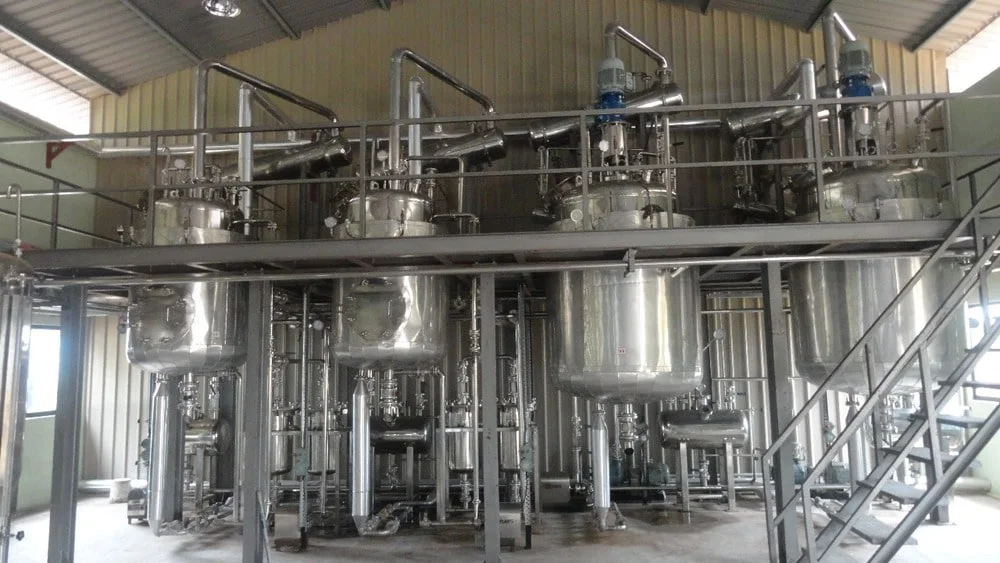
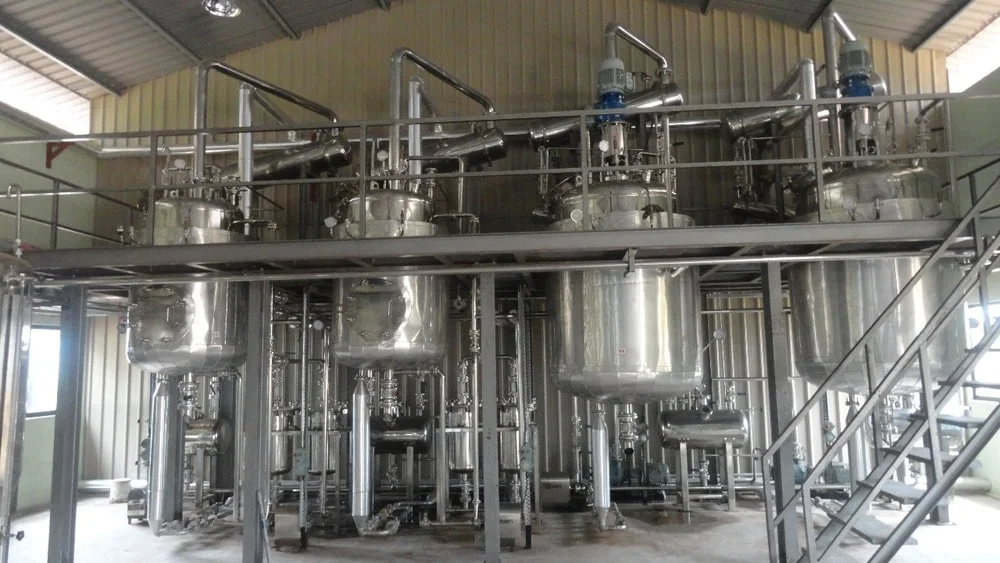
Mecha Engineering fabricates stainless steel shilajit extraction plants at its Saharanpur works and installs them at ayurvedic, herbal and nutraceutical units across Madhya Pradesh. Low temperature aqua extraction, multi-stage filtration and vacuum concentration, sized from 100 litre pilot units to full commercial lines.
Madhya Pradesh already moves herbal raw material at scale. The forest belt across Mandla, Dindori, Balaghat, Chhindwara, Shahdol and Anuppur collects and grades medicinal plant material, while Indore, Pithampur, Ujjain, Dewas and Bhopal convert it into extracts, formulations and finished packs. The handling discipline a shilajit line needs is therefore already in the building.
What is usually missing is the finishing end. Shilajit arrives in MP as a bought-in raw material, and a unit used to grinding and blending dry herb has no vacuum concentration stage and often no filtration beyond a strainer. As a leading manufacturer of shilajit extraction plant in Madhya Pradesh, Mecha Engineering most often quotes exactly that gap: the filtration skid and the low temperature concentration unit, sized to sit beside equipment you already run.
These are the points Madhya Pradesh buyers check before releasing a purchase order, so we put them in writing rather than in a brochure line.
SS 304 or SS 316 and SS 316L on all product contact surfaces, backed by mill test certificates issued in your company name.
Water run, vacuum hold and leak test at our Saharanpur shop. Send a raw shilajit sample and we run a yield trial before the plant leaves.
Erection, piping tie-in, utility connection, commissioning and operator training at your Madhya Pradesh site, covered in the supply scope.
You buy from the fabricator, not a trading house. No dealer margin, and any design change is quoted against actual material and labour.
Every feature below exists to protect one of two things: the bioactive fraction in your raw material, or the hours your operator spends on a batch.
Multi-stage filtration separates sand, rock grit and insoluble matter from the dissolved fraction, so what reaches the concentration stage is clean enough for pharmaceutical grade output rather than needing a second correction pass.
Jacketed heating with a PT100 sensor in the liquid holds the set point through the whole extraction cycle. Fulvic acid, humic fraction and the mineral content keep their profile instead of degrading at the vessel wall.
Staged soaking, controlled agitation and a second wash on the residue pull the maximum resin out of the raw material with minimal waste. Less raw shilajit per kilo of finished resin is where the return on the plant shows up.
Programmable controls handle extraction timing, temperature ramps and safety interlocks, with batch logging on the HMI. Batch to batch consistency stops depending on which operator is on shift.
Water is pulled off under vacuum at a low boiling point, so the extract thickens to resin consistency without ever seeing the temperature that flat evaporation would need.
Internal 220 grit mirror finish, coved corners, CIP spray ball and a bottom flush outlet. Changeover and washdown are a short job rather than a shift, which matters on a multi-product floor.
Buy the full line, or add the one stage you are missing. Send your process sheet and we will tell you which of these fits.
The core unit. Jacketed SS vessel with anchor agitation, temperature control and a bottom strainer, where raw shilajit is dissolved in purified water at controlled temperature.
Suits every shilajit line, pilot to commercial
Coarse basket, bag filter, sparkler or cartridge filter in sequence, with a transfer pump between stages. This is the stage that decides your final clarity and grit level.
Suits units correcting a purity complaint
Vacuum evaporator with condenser, receiver and vacuum pump, taking the filtered liquid down to a thick, pourable concentrate at low temperature.
Suits resin makers protecting fulvic acid
Final moisture reduction, holding kettle with slow stirrer and a filling arrangement for jars, so the resin leaves at a consistent viscosity instead of setting in the vessel.
Suits brands packing retail resin jars
Where the output has to be a free flowing powder for capsules, tablets or gummies, the concentrate is spray dried with or without a carrier at a controlled inlet temperature.
Suits capsule and supplement manufacturers
A 100 or 250 litre version of the same line for R and D, sample lots and buyer trials, built so the recipe you prove on it scales to the commercial vessel without rework.
Suits new entrants and export sampling
Standard build for an aqua extraction line. Every line below is changed to order, so treat this as the starting point for your enquiry rather than a fixed model list.
| Parameter | Standard offering | Options on request |
|---|---|---|
| Vessel Capacity | 100, 250, 500, 1000, 2000 and 3000 litres | Up to 5,000 litres, and multi-vessel batteries |
| Extraction Medium | Purified water, single or double stage soak | Hydro-alcoholic wash for specific marker profiles |
| Material of Construction | SS 304 shell, SS 304 contact parts | SS 316 or SS 316L contact parts for export and GMP duty |
| Internal Finish | 220 grit mirror polish, around 0.4 micron Ra | Electropolished finish for pharma duty |
| Heating Arrangement | Limpet coil or dimple jacket, steam or electric | Thermic fluid, or hot water circulation for tighter low temperature control |
| Operating Temperature | Ambient to 60 degrees Celsius on the extraction stage | Programmed ramp and hold profile through the PLC |
| Agitation | Anchor stirrer with scraper, geared motor, top entry | VFD speed control, bottom entry magnetic drive |
| Filtration Train | SS mesh basket, bottom strainer and bag filter | Sparkler filter press, cartridge housing, membrane or ultrafiltration stage |
| Concentration Stage | Vacuum evaporator with shell and tube condenser | Thin film or wiped film evaporator, multi-effect arrangement |
| Vacuum System | Water ring vacuum pump with receiver | Oil sealed pump, chilled water condenser, vent condenser |
| Final Output Form | Thick resin at controlled moisture | Spray dried free flowing powder, or granules |
| Insulation and Cladding | 50 mm mineral wool under SS 304 cladding | Higher thickness where hot utilities are used |
| Control System | Local panel with temperature indicator and timer | PLC with HMI, recipe storage, batch report, SCADA link |
| Documentation | GA drawing, MOC certificate, test report, manual | DQ, IQ, OQ protocols, weld map, polish and pressure records |
Scroll the table sideways on a mobile screen. Send your raw material grade, batch size and target output form and we will fill this sheet in against your process.
The output form and the buyer's specification decide the plant, not the other way around. This is the shortlist we work through with a Madhya Pradesh buyer on the first call.
| Configuration | Core stages | Output | Typical Madhya Pradesh buyer |
|---|---|---|---|
| Basic Aqua Extraction | Extraction vessel and basket filtration | Filtered liquid for onward processing | Ayurvedic units in Ujjain and Jabalpur |
| Purification Line | Extraction with multi-stage filtration skid | Clarified extract, grit and insolubles removed | Herbal processors moving up from strainer filtration |
| Resin Line | Extraction, filtration and vacuum concentration | Thick shilajit resin at controlled moisture | Resin packers in Indore and Bhopal |
| Powder Line | Resin line plus spray dryer | Free flowing powder for capsules and tablets | Nutraceutical units at Pithampur and Dewas |
| Export Grade Line | Full line with PLC, batch logging and SS 316 | Resin or powder with batch records and COA | Extract suppliers selling to national brands |
| Pilot and R and D | 100 to 250 litre version of any of the above | Sample lots and trial batches | New entrants testing the market |
| Stage Addition | One unit added to an existing hall | Whichever stage is currently the bottleneck | Herbal units that only lack concentration |
Not sure which row you belong to? Share your raw material source and the specification your buyer audits, and we will confirm the configuration along with an indicative yield range.
Six stages from raw exudate to finished resin or powder. Your operator sees the same sequence on every batch, which is what keeps the output consistent.
Incoming raw shilajit is graded, loose rock and visible foreign matter are removed, and the lot is broken down so it dissolves evenly instead of in lumps.
Material goes into the extraction vessel with measured purified water. The soak runs to a set ratio and time so every batch starts from the same baseline.
Jacket heating holds the batch at the low set point while the agitator keeps the solids in suspension. The soluble fraction goes into the water, the rock does not.
The liquid passes through basket, bag and fine filtration in sequence. Grit, sand and insoluble matter drop out stage by stage rather than all at once.
Water is removed under vacuum at low temperature until the extract reaches resin consistency. Condensate collects in the receiver and is drained off.
Output is held at the target moisture and filled as resin, or sent forward to the spray dryer where a free flowing powder is required.
Classical rasayana preparations, shilajit vati and combination formulations. AYUSH and GMP units ask for SS 316 contact parts and IQ or OQ documentation.
Capsule, tablet and gummy makers who have to hold a declared fulvic acid percentage batch after batch, usually with PLC batch logging behind it.
Direct to consumer jars where texture, colour and purity are what the customer judges, so filtration and moisture control carry the whole product.
Units shipping to the US, Gulf and European markets, buying for traceability, heavy metal control and a document set a third party auditor will accept.
B2B suppliers selling standardised shilajit extract to formulators, who need volume and a consistent marker level rather than retail packing.
Units in the Mandla, Dindori and Chhindwara belt already handling medicinal plant material, adding shilajit as a higher value line off the same floor.
Dispatch and site service run out of Saharanpur to all 55 districts of Madhya Pradesh. These are the locations we work in most often.
Location not on the list? The list is only where we have worked most recently. Site visits, erection and after-sales service cover every district in Madhya Pradesh, plus neighbouring Uttar Pradesh, Rajasthan, Gujarat, Maharashtra and Chhattisgarh.
Straight answers to what Madhya Pradesh buyers ask before and after a site visit.
Mecha Engineering Pvt. Ltd. designs and fabricates shilajit extraction plants at its own works at Village Meharbani on Behat Road, Saharanpur, Uttar Pradesh, and supplies them across Madhya Pradesh. The company was set up in 2022 and builds extraction, filtration, drying and process equipment for pharmaceutical, ayurvedic, nutraceutical, food and cosmetic units throughout India and for export.
Two ways. The extraction stage runs as a low temperature aqua process with a PT100 sensor in the liquid and jacket control holding the set point, so the batch never overshoots. The concentration stage is done under vacuum, which lowers the boiling point and takes the water off without the heat load that open evaporation would need. Send a sample and we can run a trial batch before dispatch so you see the retained value on your own material.
Single vessels run from 100 litres for pilot and R and D work up to 5,000 litres for commercial lines, with multi-vessel arrangements where throughput demands it. Tell us the daily raw shilajit quantity you want to process and the output form you sell, and we work backwards to the vessel size and the number of batches per shift.
Yes. Extraction, filtration and vacuum concentration are common to both. Resin is drawn off at the end of concentration at a controlled moisture level, while powder needs a spray dryer added after that stage. Most units start with the resin line and add the dryer once capsule or tablet orders justify it, so we size the concentration stage for that addition from day one.
The standard build uses SS 304 for the shell and product contact parts. SS 316 and SS 316L are used where a pharma or export audit requires it. Mill test certificates for every plate and pipe are issued in your company name and handed over with the plant along with the GA drawing and test report.
It depends on your raw material and your buyer. A clean, well sorted lot going into a domestic ayurvedic formulation may pass on basket and bag filtration alone. A retail resin jar or an export lot usually needs a sparkler or cartridge stage after that, and some buyers ask for a membrane stage. We quote the filtration skid as a separate line item so you can see what each stage costs before you commit to it.
Yes, erection, piping tie-in, utility connection, water trial, the first shilajit batch and operator training at your Madhya Pradesh site are part of the supply scope. Where we are adding a stage to a hall you already run, the tie-in is planned around your production schedule so the existing line loses as little time as possible.
Standard handover covers the general arrangement drawing, material of construction certificates, hydro and vacuum test reports, weld and polish records, the operating and maintenance manual and a spare parts list. DQ, IQ and OQ protocols, along with a validation document set, are prepared on request for GMP and export buyers.
Standard vessels ship in 4 to 8 weeks from order confirmation and full turnkey lines take 10 to 12 weeks. Road transit from Saharanpur to Indore, Bhopal or Jabalpur adds roughly two to three days. Freight is quoted at actual cost, and for larger vessels we arrange the trailer, route survey and unloading crane along with the dispatch.
Yes. Common jobs include adding a filtration skid to a plant that is only using a basket strainer, adding vacuum concentration to a unit still evaporating in open kettles, replacing an agitator and gearbox, adding a PLC panel to a manual line, and repolishing an internal surface that has lost its finish. Send photographs and a nameplate reading to start.
Usually two things. A multi-stage filtration skid, because a basket strainer will not take out the fine grit that shows up in a finished resin jar, and a vacuum concentration unit, because open kettle evaporation puts more heat into the batch than the fulvic acid fraction tolerates. Extraction itself can often be done in a jacketed vessel you already own. Send photographs and nameplate readings of your current equipment and we will tell you what carries over.
Call +91-9084351006 or +91-7500378000, send a WhatsApp message, or email info@mechaengg.com with four details: the raw shilajit grade and source, the batch quantity in kilograms, the output form you want, and whether you need PLC controls and export documentation. A specification sheet and price come back within one working day.
Share the batch size, what equipment you already run and the output form you sell. Our Saharanpur engineering team returns a specification sheet, layout drawing and delivered price for your Madhya Pradesh site so you can compare on paper rather than on promises.